• About
  • Careers
  • Services
  • Partnership
  • Process
  • ConeMount
  • Blog
  • About
  • Careers
  • Services
  • Partnership
  • Process
  • ConeMount
  • Blog
Request a Quote
  • October 13, 2026
  • Reata Engineering

Contract Manufacturer vs. Machine Shop: Where Reata Fits In

Contract Manufacturer

Every manufacturing company has its own strengths. Many shops are set up to efficiently quote, machine, inspect, and ship individual components. For straightforward parts and shorter production runs, that model works well.

Reata started similarly, specializing entirely in machining. Over time, however, we continued adding capabilities, engineering resources, quality systems, and processes that allowed us to take on more of the work surrounding a part. That progression is what has turned Reata from a machine shop into a contract manufacturing partner. 

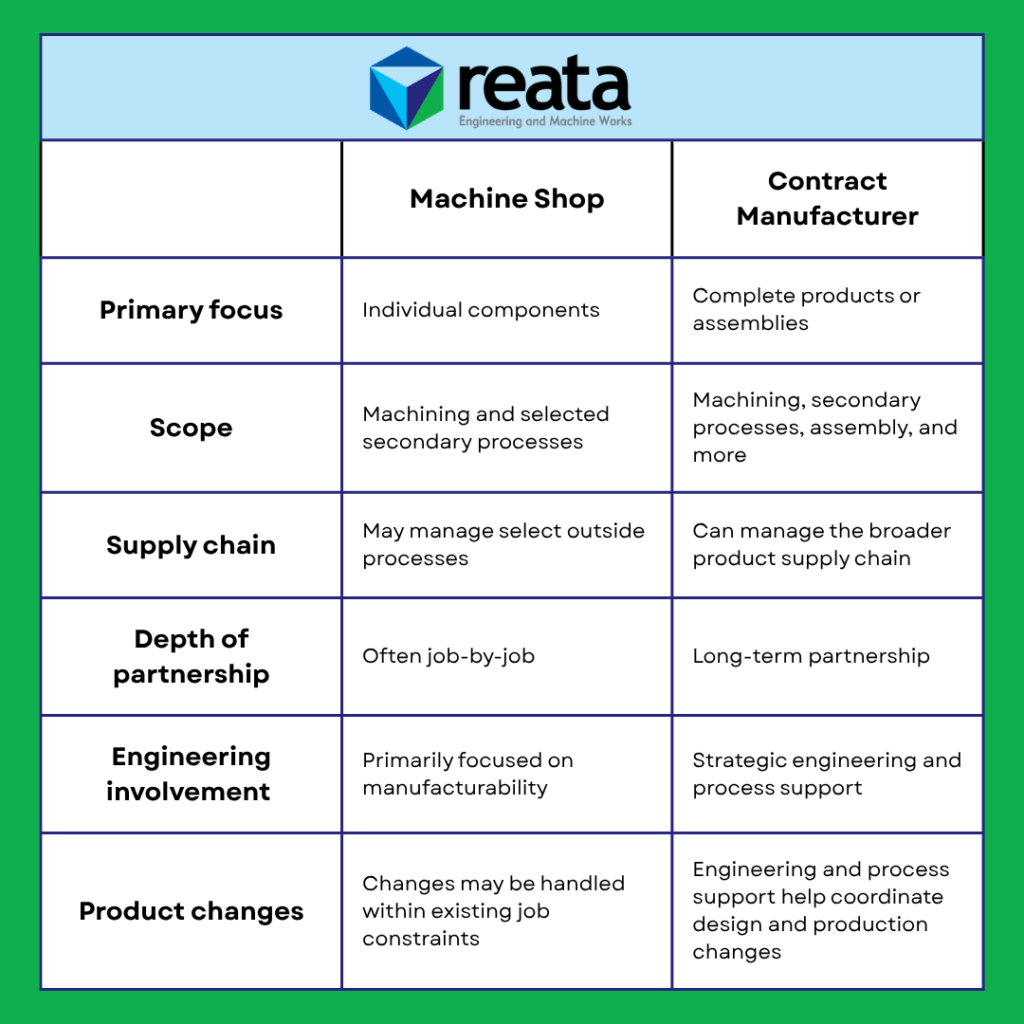
While neither model is inherently better than the other, the right choice for your project depends on what you need from your manufacturing partner. Here are the major distinctions:

1. Scope

It’s common for machine shops to machine components and then send them along to the next supplier to take on outside processes like plating or finishing. A contract manufacturer can take responsibility for a much larger portion of that process.

At Reata, a project might involve machining multiple components, managing outside processes, performing secondary machining, completing mechanical or electromechanical assembly, installing pins or helicoils, inspecting the finished product, and packaging everything together for shipment. As a result, the customer receives a finished assembly rather than a collection of individual parts that still need to be coordinated. The more complex the product, the more valuable that consolidation can become, with fewer handoffs and fewer opportunities for something to fall through the cracks. 

2. Supply Chain Coordination 

A machine shop may handle material procurement and coordinate outside processes for the work it is performing. A contract manufacturer can manage a much larger portion of the product’s supply chain. 

For Reata, that can mean sourcing and tracking material, managing outside processing, manufacturing multiple components, assembling them, and delivering them together. When a customer has dozens of components going into one product, this coordination is critical. Instead of managing a network of suppliers for individual pieces, the customer can work with one partner responsible for bringing those pieces together. 

That also gives the customer a single point of contact for questions, updates, and production status. If one missing component can hold up an entire assembly, having visibility into the full order matters. 

3. Engineering Expertise 

Machine shops often have engineering teams focused on programming, tooling, and manufacturability. A contract manufacturing partner can bring that engineering expertise into the larger product and production strategy.

When a customer sends Reata a new product, we think critically about how parts will fit together and whether opportunities exist to make the product easier or more efficient to produce. Sometimes what is specified on the drawing isn’t quite what will work once the parts reach assembly. Having engineers involved gives us the ability to identify those issues and collaborate with our customers on a solution before they become larger downstream problems. 

The hands-on engineering support offered by a contract manufacturing partner like Reata can also be valuable when plans change. If a customer needs to uprev a design, change a priority, or adjust something during production, we can help determine the best path forward and work through what those changes mean for the manufacturing process. 

4. Depth of Partnership 

Machine shops often operate on individual jobs. Contract manufacturing relationships are more likely to develop around ongoing programs, blanket orders, and long-term production.

That long-term relationship changes how the manufacturer can support the customer. We have maintained relationships with many of our customers for decades. Over that time, we build knowledge around their processes, products, requirements, and history, and we’re able to use that knowledge on future orders. We understand the product’s history, know what has worked before, and can apply that context when new challenges arise.

When Should You Partner with a Contract Manufacturer? 
Contract Manufacturer

If you need a straightforward machined component, a machine shop may be the right fit. But if your project involves multiple components, complex assemblies, secondary processes, significant documentation, supply chain coordination, engineering collaboration, or ongoing production, a contract manufacturing partner may be what you’re looking for. 

33 years ago, Reata started as a machine shop. While machining is still at the center of what we do, the engineering, quality, assembly, supply chain, and program support we’ve built around it allow us to take on a much broader role. We’ve had decades to build those capabilities, and they’re what allow us to support customers beyond the individual part.

Are you looking for a true contract manufacturing partner to take on your future projects? Don’t hesitate to get in touch with our team. 

Recent Posts

  • Contract Manufacturer vs. Machine Shop: Where Reata Fits In
  • The Best Manufacturing Partner Is an Extension of Your Team
  • Reata’s Continuous Machine Maintenance Creates Better Customer Outcomes
  • How Reata Continuously Improves Assembly Processes to Better Support Customers
  • The Invisible Infrastructure Underneath Innovation: Why Contract Manufacturing Matters
  • Contract Manufacturing Isn’t a Commodity, And Your Parts Shouldn’t Be Treated Like One
  • Continuous Improvement Enhances the Customer Experience (Even When They Don’t See It!)
  • Software Is a Force Multiplier in Our Contract Manufacturing Environment
  • What Impacts Lead Times in Contract Manufacturing?
  • A Workforce Development Strategy That Works: Internal Lunch-and-Learns
  • Colorado’s New AI Law: What It Means for Your Parts and Partnership with Reata
  • Reata’s Brand-New Customer Portal Removes the Black Box in Contract Manufacturing
  • Contract Manufacturing, Reimagined: How Reata’s Agentic System Delivers Scale and Speed
  • CMM Inspection at Reata: How Our New 3D Scanner Streamlines This Process
  • Reata’s AI-Powered Vendor Communication Platform Enables On-Time Delivery
  • Sustainability in Action at Our Colorado Machine Shop
  • Where Manufacturing AI Fits (and Where It Doesn’t) in Our Precision Machine Shop
  • Inside the Mindset of Reata’s Leadership Team, Built on Accountability and Transparency
  • How Reata Selects the Right Plating Vendor for Your High-Precision Parts
  • The Cost of Redesign Is Time! Avoid Delays with Design for Manufacturing
  • Decoding the Cost of Machined Parts
  • How Manufacturing AI Is Helping Reata Preserve Culture, Consistency, and Customer Trust
  • Quality Assurance Isn’t Just a Department; It’s Part of Our Culture!
  • Why Automation Makes Sense for Low-Volume Production
  • Prototype Machining Services That Don’t Disrupt Production
  • Our Key to Being a Customer-Focused Manufacturer? Delivering What Matters Most!
  • Are You Including the Right Information in Your RFQs? Advice from Our Colorado Machine Shop
  • Manufacturing Engineers Are Problem Solvers—and Contract Manufacturing Is Full of Problems
  • The Global Web of American Manufacturing: Why International Connections Matter
  • The True Test of a Precision Machine Shop? How We Respond to Mistakes
  • Why “Approximately Correct” Is Better Than “Perfectly Wrong” in Contract Manufacturing
  • Why Your Contract Manufacturing Partner Should Handle Production AND Inspection
  • Identifying and Overcoming Bottlenecks to Maximize Manufacturing Efficiency
  • “Do Or Do Not; There Is No Try.” Wise Words from Yoda, the Mascot of Our Precision Machine Shop
  • What Should You Look for in a Manufacturing Partner? A Can-Do Attitude!
  • Better People, Better Parts: How Reata’s Talented Team Drives Our Customers’ Success
  • Engineering Expertise at Reata: Supporting Complex Designs for Superior Results
  • Efficiency, Transparency, and Accuracy: Reata’s Journey with Datanomix
  • Why Reata Added Passivation and Laser Engraving to Our In-House Capabilities
  • Reata’s Partnership with NIMS Sets the Stage for Workforce Development
  • Reata’s Approach to Data-Driven Decision-Making
  • How Our New 3D Printing Technology Increases Versatility and Customization at Our Precision Machine Shop
  • How Reata Successfully Quoted a 1,000-Piece Medical Assembly in Record Time
  • Collaboration Is Key in Contract Manufacturing
  • How Reata Standardizes Training and Streamlines Production with STS
  • Optimizing Our Outside Processing Services with In-House Masking
  • Innovative Solutions Through Partnership: Our Approach to Problem Solving
  • Great Leaders Run Great Precision Machine Shops
  • Why New Part Meetings Are a Critical Step in Our Process
  • Reata Achieves ISO 13485 Certification for Medical Device Manufacturing
  • The Door to Our Precision Machine Shop is Always Open
  • How to Approach Tight Tolerances in Complex CNC Machining
  • How Our Cutting-Edge Proactive Maintenance Program Benefits Customers
  • Machining vs. Extruding Heat Sinks: Which Option Is Better?
  • How Our Turnkey Assembly Services Benefit Customers
  • DFM Tip: Why You Should Model to the Mean, Not the Nominal
  • Our Software Increases Visibility for Contract Manufacturing Customers
  • Why We Use Pre-Processed Parts for Complex CNC Machining Jobs
  • Reduce Contract Manufacturing Costs with Extrusion
  • The Future of Contract Manufacturing Requires Your Participation
  • How 5-Axis Machining Accelerates the Prototyping Process
  • 5 Ways Reata’s Kanban Approach to Assembly Benefits Customers
  • Use DFM Principles for Superior Prototype Machining Services
  • DFM 101: 3 Reasons Reata Is a Superior DFM Partner
  • DFM 101: Getting Started with Design For Manufacturability
  • The Importance of a Complete PO in Precision Machining
  • How Reata’s Software Investments Benefit Contract Manufacturing Customers
  • How to Use Datums to Get the Part You Want
  • Celebrating Our 30th Anniversary with a Look Back at How We Got Here
  • How We’re Using AI to Improve Our Manufacturing Processes
  • Why Low-Volume, High-Mix Shops Make Great Manufacturing Partners
  • A One-Stop Shop for Complex Assembly Projects
  • How Industry 4.0 Is Transforming Our Contract Manufacturing Shop
  • How Our New Scanning CMM Improves Inspection Capabilities
  • 5 Reasons Contract Manufacturing Customers Love Reata’s Quotes
  • Reata’s Customer Service Standards as Your Contract Manufacturing Partner
  • Decoding Machinist Speak: Surface Finish vs. Finishing in Contract Machining
  • Complex CNC Machining Is Our Specialty
  • 5 Reasons to Grow Your Contract Manufacturing Career at Reata Engineering
  • What to Know About Electroless Nickel Plating Services
  • How Measuring Our Performance against Manufacturing Industry Benchmarks Keeps Us Competitive
  • How 3D Printing Technology Improves Our Contract Manufacturing Services
  • Choosing the Right Aluminum Plating Method
  • What 5-Axis Machining Capabilities Tell You about a Machine Shop
  • Decoding Machinist Speak: Measurement Conventions
  • 6 Benefits of Electropolishing for Stainless Steel Parts
  • 4 Ways Reata’s Automation Solutions Benefit Customers
  • Why True Position Is a Precision Machine Shop’s Best Friend
  • Considerations for Plating Precision Machined Parts
  • How to Convey Intent in Precision Machining Designs
  • 5 Reasons to Reshore Manufacturing Operations
  • How to Avoid Tolerance Stacking Problems When Designing Mating Parts
  • Inside Reata’s Successful Summer Internship Program
  • How Lights Out Manufacturing Benefits Precision Machining Customers
  • 5 Ways Reata Is Mitigating Manufacturing Workforce Issues for Our Customers
  • 6 Reasons to Tell Your Precision Machining Partner about Your Part’s Application
  • Could Your Complex Parts Benefit from GD&T Profile Callouts?
  • How Industry 4.0 Helps Us Meet Customer Needs
  • 5 Ways Reata Overcomes Global Manufacturing Challenges
  • DFM Tip: 4 Facts to Know About Perpendicularity
  • Can’t Find These 3 Popular Materials? Talk to Your Contract Manufacturing Partner
  • What Makes Reata Engineering an Engineer-Friendly Precision Machine Shop
  • How a Happy Manufacturing Team Makes for Happy Customers
  • DFM Tip: 5 Best Practices for Revision Control in Contract Manufacturing
  • A Single-Source Precision Machining Solution for Assemblies
  • Could Your Part Benefit From 5-Axis Machining?
  • DFM Tip: 3 Ways to Improve Your Prints and Get Better CNC Machined Parts
  • Best Practices for Achieving Color Consistency in Anodized Parts
  • DFM Tip: How to Handle Flatness and Parallelism Specifications in Your Print
  • DFM Tip: Clarify Cosmetic Surfaces to Reduce Cost and Lead Time for Contract Manufacturing
  • Best Practices for Measuring Holes in CNC Machined Parts
  • 5 Benefits of Using GD&T in Complex CNC Machining
  • DFM Tip: Best Practices for Thread Design in Complex CNC Machining
  • Low Volume Swiss Turning Services for Complex Assembly Components
  • How Reata Engineering Expertly Manufactures Titanium Medical Components
  • Creative Solutions to Sourcing Problems in Contract Manufacturing
  • CNC Machining Case Study: TITAN CSR™ Retractor System for the Medical Industry
  • How Machine Monitoring Technology Helps Productivity for Contract Manufacturing
  • To Cast or Not to Cast? 4 Reasons to Convert from Casting to Contract Machining for Low-Volume Parts
  • 5 Ways Reata Engineering Solves Material Sourcing and Supply Chain Problems
  • How Availability, Machinability, and Cost Factor Into Choosing a Stainless Steel Grade
  • Top 3 Non-Machinable Features to Avoid Designing Into Your Part
  • Reata Engineering’s Customer-Focused Approach to Design Iterations
  • Reata Engineering’s Proven Process for Manufacturing Success
  • The Advantages of Working with a Digital Machine Shop
  • 9 Ways Our Assembly Services Will Make Your Life Easier
  • What It Means for Us to Be a Customer-Focused Company
  • Why Reata Engineering Excels at Manufacturing Complex Parts
  • Why AS9100 Certification Matters (Even If You Aren’t In Aerospace Manufacturing)
  • Reata Engineering promotes Christina Collette to Director of Operations – Denver Colorado USA February 12th, 2021
  • 5 Reasons to Find a Machine Shop with Multi-Tasking Machines
  • Reata Engineering appoints new Quality Manager
  • Reata Engineering gave a virtual shop tour at RMTMA Ignite
  • Reata Engineering showcased its capabilities at the Colorado Advanced Manufacturing Association B2B conference
  • More New Capabilities
  • Reata in the News!!
  • Done in One

7822 South Wheeling Court,
Suite AEnglewood, CO 80112

(303) 936-1350

(303) 936-1350

Facebook Twitter Linkedin

Standard Terms and Conditions of Sale

Privacy Policy 

About
Careers
Services
Machining
Assembly
Partnership
Process
Blog

© All rights reserved

Designed by Factur