Every manufacturing company has its own strengths. Many shops are set up to efficiently quote, machine, inspect, and ship individual components. For straightforward parts and shorter production runs, that model works well.
Reata started similarly, specializing entirely in machining. Over time, however, we continued adding capabilities, engineering resources, quality systems, and processes that allowed us to take on more of the work surrounding a part. That progression is what has turned Reata from a machine shop into a contract manufacturing partner.
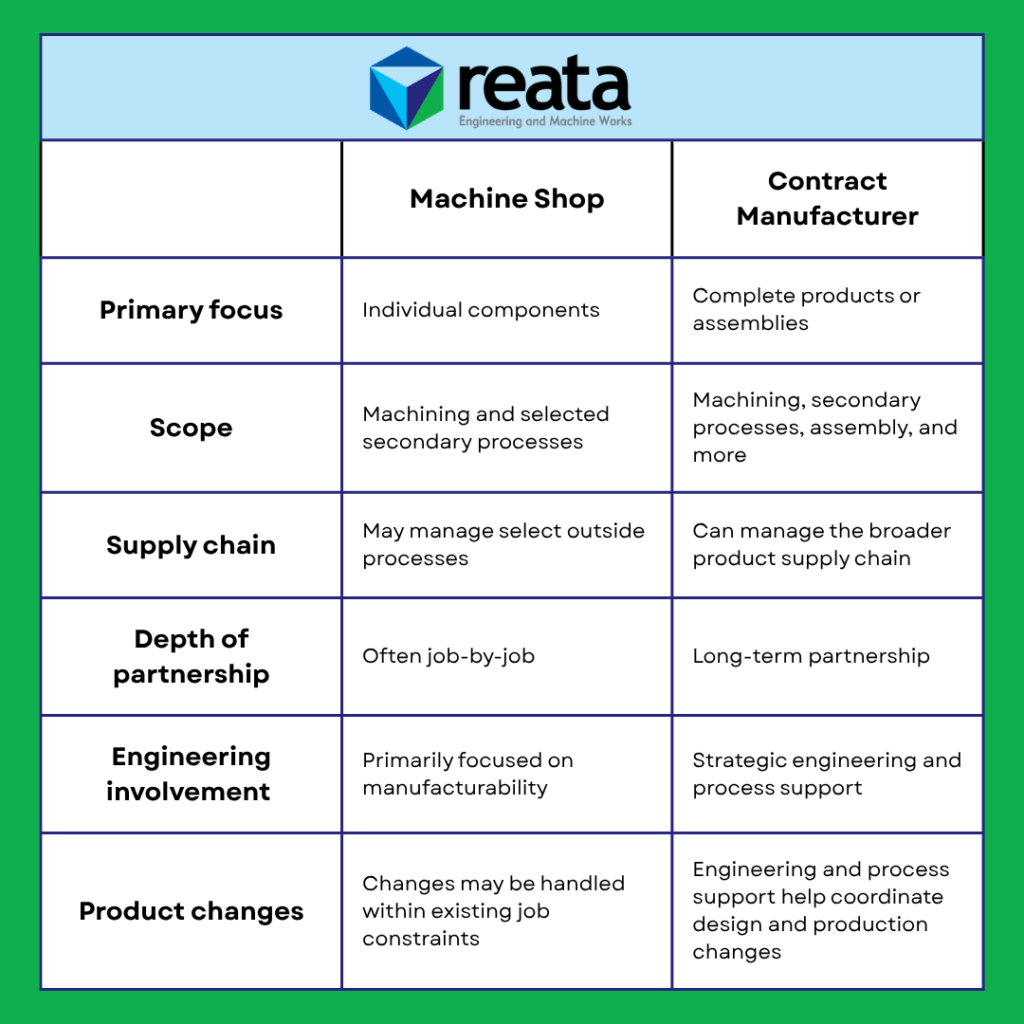
While neither model is inherently better than the other, the right choice for your project depends on what you need from your manufacturing partner. Here are the major distinctions:
1. Scope
It’s common for machine shops to machine components and then send them along to the next supplier to take on outside processes like plating or finishing. A contract manufacturer can take responsibility for a much larger portion of that process.
At Reata, a project might involve machining multiple components, managing outside processes, performing secondary machining, completing mechanical or electromechanical assembly, installing pins or helicoils, inspecting the finished product, and packaging everything together for shipment. As a result, the customer receives a finished assembly rather than a collection of individual parts that still need to be coordinated. The more complex the product, the more valuable that consolidation can become, with fewer handoffs and fewer opportunities for something to fall through the cracks.
2. Supply Chain Coordination
A machine shop may handle material procurement and coordinate outside processes for the work it is performing. A contract manufacturer can manage a much larger portion of the product’s supply chain.
For Reata, that can mean sourcing and tracking material, managing outside processing, manufacturing multiple components, assembling them, and delivering them together. When a customer has dozens of components going into one product, this coordination is critical. Instead of managing a network of suppliers for individual pieces, the customer can work with one partner responsible for bringing those pieces together.
That also gives the customer a single point of contact for questions, updates, and production status. If one missing component can hold up an entire assembly, having visibility into the full order matters.
3. Engineering Expertise
Machine shops often have engineering teams focused on programming, tooling, and manufacturability. A contract manufacturing partner can bring that engineering expertise into the larger product and production strategy.
When a customer sends Reata a new product, we think critically about how parts will fit together and whether opportunities exist to make the product easier or more efficient to produce. Sometimes what is specified on the drawing isn’t quite what will work once the parts reach assembly. Having engineers involved gives us the ability to identify those issues and collaborate with our customers on a solution before they become larger downstream problems.
The hands-on engineering support offered by a contract manufacturing partner like Reata can also be valuable when plans change. If a customer needs to uprev a design, change a priority, or adjust something during production, we can help determine the best path forward and work through what those changes mean for the manufacturing process.
4. Depth of Partnership
Machine shops often operate on individual jobs. Contract manufacturing relationships are more likely to develop around ongoing programs, blanket orders, and long-term production.
That long-term relationship changes how the manufacturer can support the customer. We have maintained relationships with many of our customers for decades. Over that time, we build knowledge around their processes, products, requirements, and history, and we’re able to use that knowledge on future orders. We understand the product’s history, know what has worked before, and can apply that context when new challenges arise.
When Should You Partner with a Contract Manufacturer?
If you need a straightforward machined component, a machine shop may be the right fit. But if your project involves multiple components, complex assemblies, secondary processes, significant documentation, supply chain coordination, engineering collaboration, or ongoing production, a contract manufacturing partner may be what you’re looking for.
33 years ago, Reata started as a machine shop. While machining is still at the center of what we do, the engineering, quality, assembly, supply chain, and program support we’ve built around it allow us to take on a much broader role. We’ve had decades to build those capabilities, and they’re what allow us to support customers beyond the individual part.
Are you looking for a true contract manufacturing partner to take on your future projects? Don’t hesitate to get in touch with our team.